How I got into Stanford
People really ask me how I got into Stanford a lot, and I always brush it off because I’m a little embarrassed by the question. I think people deserve an answer. It’s just not a short one. It can’t be the short answer they’re looking for, because that wouldn’t be useful.
Firstly, I’ll say what happened, because I think an advice post is kind of worthless without it. I applied to Stanford, Harvard, Princeton, and Caltech and got into all four.1 I don’t say that to flex.2 I say it because I have all of the receipts here, and if you’re going to evaluate them, you should obviously know the outcome. Below are my activity list, the essays, and even the notes I wrote myself about how to write the essay, so you can look at everything for yourself.
Don’t try to be well-rounded
I actually think my application is particularly useful to look at because it sort of looks like the ideal of well-roundedness that everyone tells you to chase: varsity baseball, classical guitar ensemble, Science Olympiad, volunteering, valedictorian, straight A’s, good test scores,3 fifteen APs.
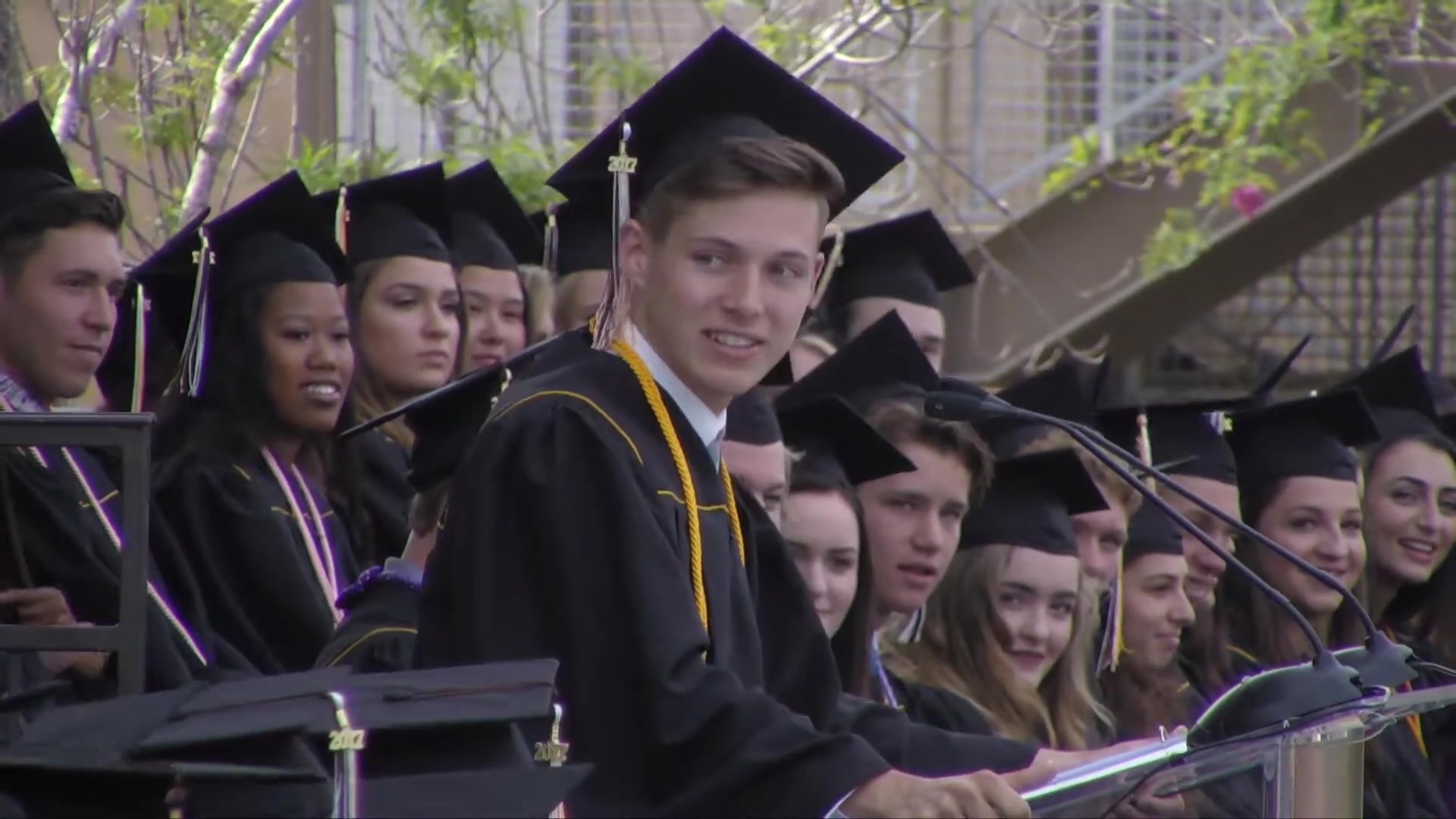 A screenshot from my valedictorian speech.
But I promise that’s not how I got in. A Stanford recruiter sees thousands of well-rounded valedictorians every year. Scores and grades can maybe get you looked at, and they can definitely keep you out, but the way to get in is to have a spike. I’ll tell you what I think mine was.
The application
The UC application asks you to declare a major for each campus, and here’s what I picked: Physics. Physics, alternate Astrophysics. Physics. Physics, alternate Astrophysics.
That’s the list I gave to the four different campuses, and that sort of tells you what you need to know about my spike. Everything else about how I tried to position myself was derived from what I was putting at the top of the application.
Here’s my whole Common App activity list, verbatim, in the order I ranked it:
- Researcher — Dorris Neuroscience Center
- Worked evenings computationally analyzing postdocs’ gene expression data to identify deficiencies and find cures for certain types of deafness
- Researcher — Yale Summer Program in Astrophysics
- Observed near-Earth asteroid 2003 LS3 and wrote Python programs to determine its likelihood of colliding with earth and potential for resource mining
- President — National History Day Team
- Nationally recognized with ‘Outstanding Entry Award’ (1 of .02% of projects) for Antarctic history documentary, coordinated 11 education workshops
- President — FIRST Robotics Competition Team 2485
- Led team of 93 in building competition robot, created programs leading to 95% member retention, coordinated 1056 team hours of STEM-related outreach
- President — Science Olympiad Team
- Led 2 teams of 10-15 for competition at both the state and regional levels, coached middle school students for 2 years, won 4 ribbons and medals
- Founder — HackToTheFuture Competition
- Founded and directed 12-hour hackathon for 43 high school students (1st in San Diego) themed around 21st century education to promote computer science
- Volunteer & Educator — Fleet Science Center & ImpulScience
- Worked with Fleet & founded nonprofit to research and design demos which teach the scientific method to border-affected schools, 300+ students to date
- Competitor — Zero Robotics
- Programmed satellites to navigate in microgravity, placed 4th worldwide in MIT virtual competition, qualifying code to compete on the ISS
- Internationally-Acclaimed Freelance Filmmaker
- Directed independent documentaries including one which relates personal tragedies of the Mexican-American border and placed 1st worldwide in festival
- Founder — Ben Clark Web Design
- Created web design company with 2 employees, contracted by 10 corporations & individuals to date including renowned Columbia physicist Brian Greene
Two things. Firstly, there’s a bit of comedy in how far I went to promote what I had done in the best possible light. Look at “Internationally-Acclaimed Freelance Filmmaker,” for instance. Maybe even more usefully, notice that baseball and guitar are not on the list. I wasn’t trying to present myself as being well-rounded. I was trying to make my case.
And that’s only the ten things that made it. I had to cut teaching Spanish to thirty kindergarteners in my free periods and my work at the Navy lab, which had to go into my work experience.
By the way, the hackathon really did happen. Here’s the flyer:
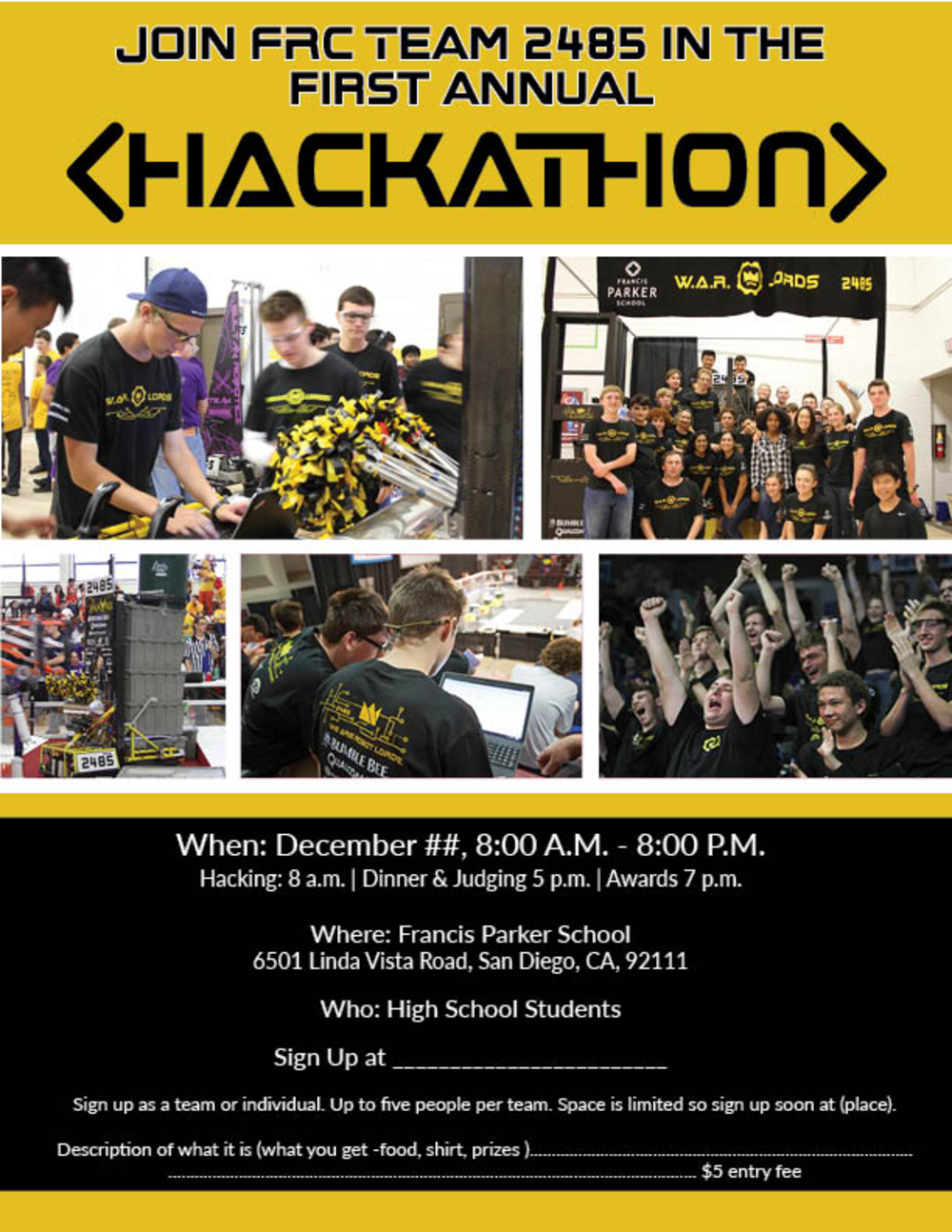 The flyer for the hackathon that I founded. I thought starting a hackathon was even better than winning a hackathon because it shows initiative, and there’s no way to fail.
My website
I really tried to focus down all of my activities into one lens that the person reading my application could very easily understand. I had made the mistake in creating my documentaries of making them too complex, and realized that people like stories that have one coherent takeaway. I decided that mine was going to be science.
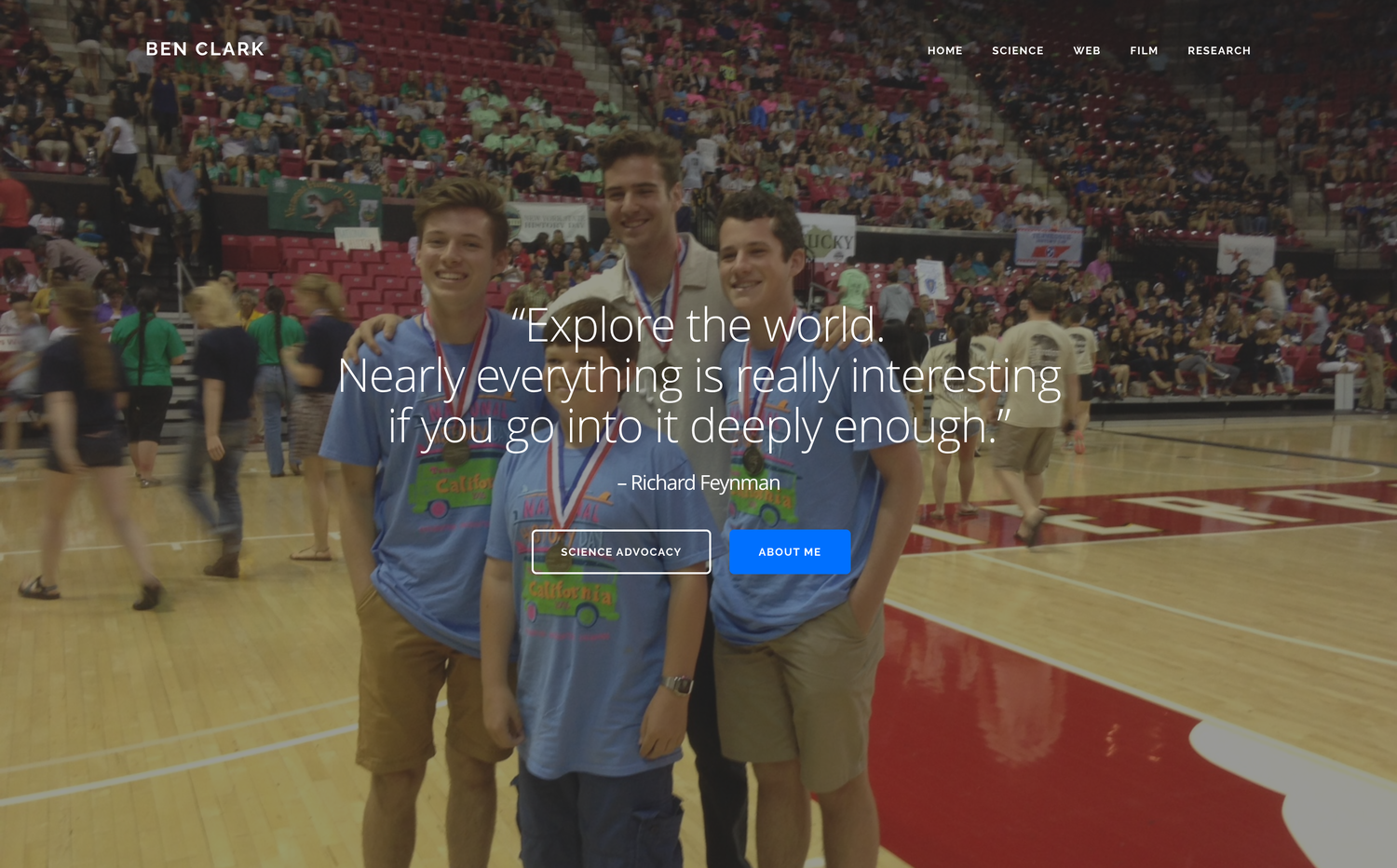 My first ever personal website, which I made for my college applications. The hero image is me and my documentary team at nationals.
The nav on the website that I created has four sections: Science, Web, Film, Research. I opened it up with a Feynman quote to really hammer home my thesis.
Science Advocacy
Web Design
Documentary Filmmaking
I even managed to tie the web section back into science. In my senior year, I reached out to the famous physicist Brian Greene on a cold email and offered to redo his website. Amazingly, he said yes, and when it was done, I asked him to write me a recommendation letter. Not only did that show ambition and initiative, but it also showed a further piece of evidence about my spike.
And then I connected everything together. I connected my nonprofit to my web development company. I connected the border to my films, and I connected the science museum back to my nonprofit. This was not obvious to me at the time, and I had to sit down and think really hard about how to make my whole story very easy to understand for the admissions officer. I wanted them to understand me in one sentence.
The details
Many of these colleges have small questions they ask. This is a place where I spent extra time, because I knew that they could say more about me than a 650-word essay could.
Princeton asks tons of these. Here are my answers, verbatim:
| Favorite book | Surely You’re Joking, Mr. Feynman |
| Favorite movie | Before Sunrise |
| Favorite website | Quora.com |
| Two adjectives your friends would use | charismatic, introspective |
| Favorite line from a book | “The waitress brought me another drink. She wanted to light my hurricane lamp again. I wouldn’t let her. ‘Can you see anything in the dark, with your sunglasses on?’ she asked me. ‘The big show is inside my head,’ I said.” Kurt Vonnegut, Breakfast of Champions4 |
| Favorite recording | “An interview I had with a space attorney named Sagi Kfir about why, well, no one owns the moon — and how it got to be that way” |
Look at the last one. This is such a good demonstration of my thesis. The question is my favorite recording, a place where most people would write down an album, but I wrote down an interview I conducted myself. An interview of a space attorney about who owns the moon. I loved music, sure, but I wasn’t going to waste an opportunity to let them put me into a box.
Here’s the email I sent that space attorney, by the way:
My name is Benjamin Clark, and I am currently a junior at Francis Parker School in San Diego… Seeing as Space and International Law are both areas of expertise of yours, we believe that speaking with you could be incredibly beneficial to the success of our project.
His response:
Thank you for reaching out to me… While I do travel quite a bit, I would be happy to hear more about what I can do to assist you.
He and I ended up talking for two hours by the airport. A few months later, he introduced me to his company’s chief scientist, who he described to me as the world’s foremost expert on asteroid mining.
Stanford asked for a shorter version, five words to describe yourself. I said inquisitive, contemplative, charismatic, fox, hedgehog.5 Fox and hedgehog are connected to an essay that I wrote elsewhere. Charismatic is here and on the Princeton list.6 I did that because I wanted the admissions officers to think of me as personable and as a good social addition to their campus. I knew that the way I was positioning myself, there was a risk of coming off as a nerd.
The essays
The essays are obviously the long-form version of this thesis. My Columbia essay, for example, opened with:
“Do you know what RAM is?”
“You mean, the animal?”
That was a real conversation that I had my freshman year on the robotics team, right before I quit. The essay is about coming back, learning to program, and eventually helping to ship the computer vision algorithm that the senior from the beginning never figured out. It ends with me becoming president of the team and calling him to let him know. He’s a genius and was very happy for me.
My Caltech essay talks about presenting science as magic when giving demos for middle schoolers and strangers at the science museum. I talk about where education can go in the future and say, “What if we could learn special relativity from Einstein? What if we could learn supersymmetry from Maria Spiropulu?” She’s a professor at Caltech.7
My UC essay about being from San Diego starts at the border: “Davíd first showed me the wall when I was fifteen.” It follows a man named Luis, who I met at a refugee shelter for deportees. It talks about the documentary I made about him, and then the Antarctic Treaty film, where I asked Sergei Khrushchev how the Cold War managed to set aside an entire continent. He leaned back in his chair, grinned, and said one word: “Science.”
The most important thing to keep in mind for your essays is that they have to be non-transferable. If another applicant could just put their name onto yours and submit it, your essay is worthless. Nobody else’s essays could have that senior or a RAM joke. Nobody else had an Antarctic documentary, and hardly anyone else could even make a documentary about the border.
The personal stuff
The UC application has a small field asking why you work. Mine said:
In 2015, my mom was diagnosed with a neurological disorder called MS. It is no coincidence that I began working the same year, in a neuroscience lab nonetheless. She is sick often and sometimes struggles to work. My earnings support her.
There’s no achievement in there. That’s on purpose, and it might still be the strongest part of my application. You are a human, and the person reading your application is a human. They are looking to connect with you. By talking about my motivation, I can tie everything together, the web company, the night shifts, into one person that is who I am, and the reader can feel that. Don’t forget that you are not in service of your application. Your application is in service of you.
The results
I remember when Stanford results came out. I walked back to the canyon behind my school to be alone when I read it. When I saw the word “congratulations,” I literally dropped my phone on the rocks.
Here’s Caltech’s email:
It’s official! On behalf of the Undergraduate Admissions Office, congratulations on your admission to Caltech! … Please let me know if there is anything I can do to help you become a Techer.
Harvard’s came from the dean and included the word transformational. Columbia’s went to my mom, who forwarded it to me with the text: “I guess u need to let me know what school u seriously want to visit.”
What does it all matter?
Here’s a note that my physics teacher sent me after I told him I got in:
I always like telling people about what you did with the numerical methods stuff that I taught you all after the AP … Nobody told you to take those steps, but you took them anyway and they paid off.8
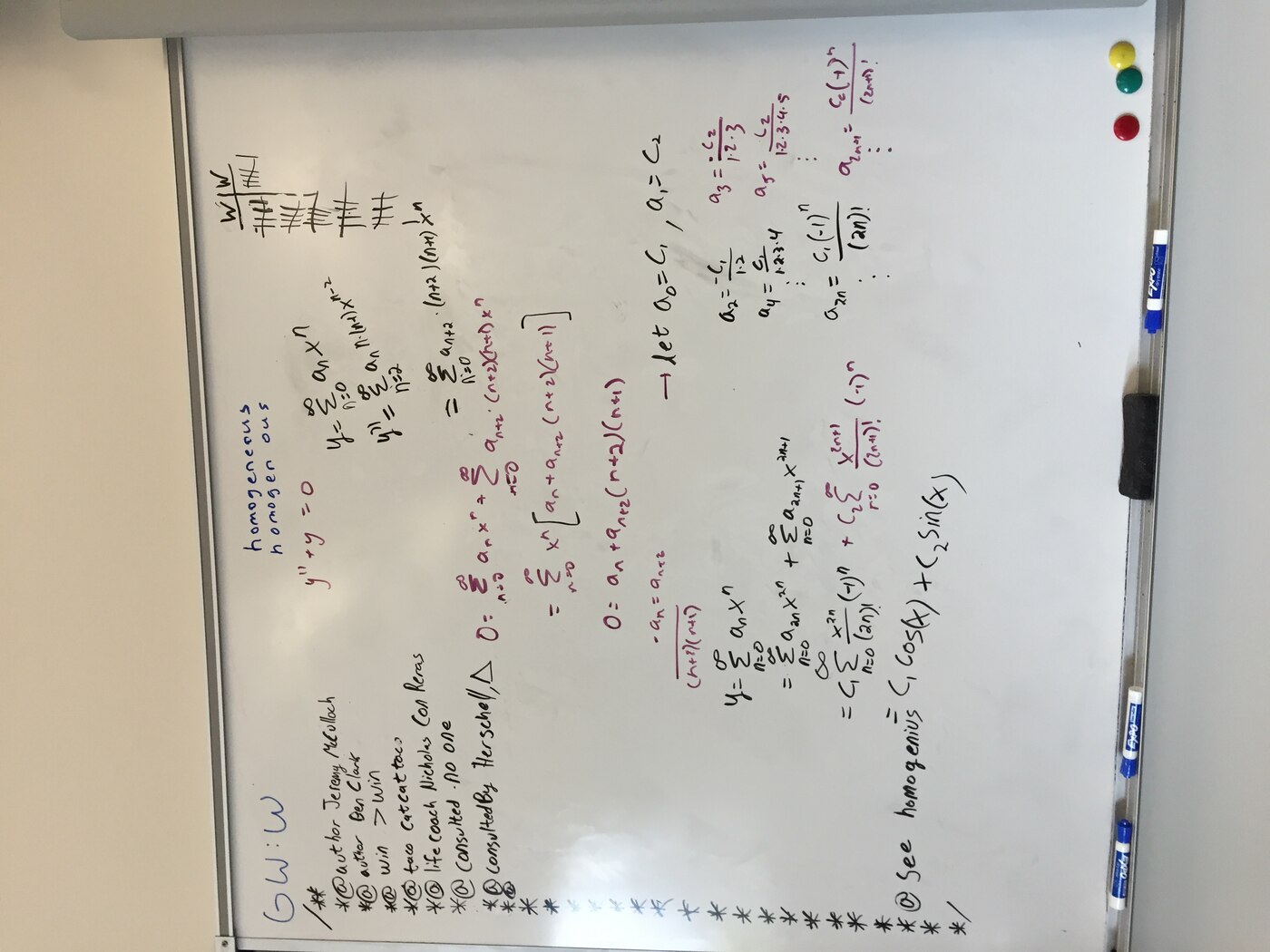 The whiteboard during some group work, senior year of high school. I think this actually says a lot about my headspace at the time.
And that, I think, is the essence of what I want to convey here. You can curate an application, but you can’t manufacture it. Instead, I think you should pick what you want to do anyway, and then decide to make that your spike. Let all the accomplishments accumulate in that one region: your films, papers, company, and code on a satellite. These are the things that the admissions officer can look at without ever meeting you.
Cold-email real adults. So many things on my application started with me reaching out to somebody and having them answer. Your grades should be good, but boring. Get them quietly, do the minimum, and then put everything else you have into your spike. Valedictorian was probably the least interesting part of my application.
And then, if you do everything right, when you sit down to describe everything, resist the urge to be impressive. You’ve already been impressive. That part is finished and will be in the numbers. Add on top a portrait of a person they want in a freshman dorm and in a classroom at their college, and give them one big, beautiful thing to remember you for.
I should also add in a data point. MIT read the exact same application and said no. Admissions are noisy. There’s a lot of luck involved, and great applications get rejected every year. I can’t say that having a spike will get you in, but I can tell you it’s a strategy that pays off even if you don’t. Spend high school predicting asteroid impacts and interviewing astronauts, and you will enter adulthood with skills, taste, proof of work, and no admissions officer can take that away from you. So build your spike for its own sake and let the colleges fall where they may.
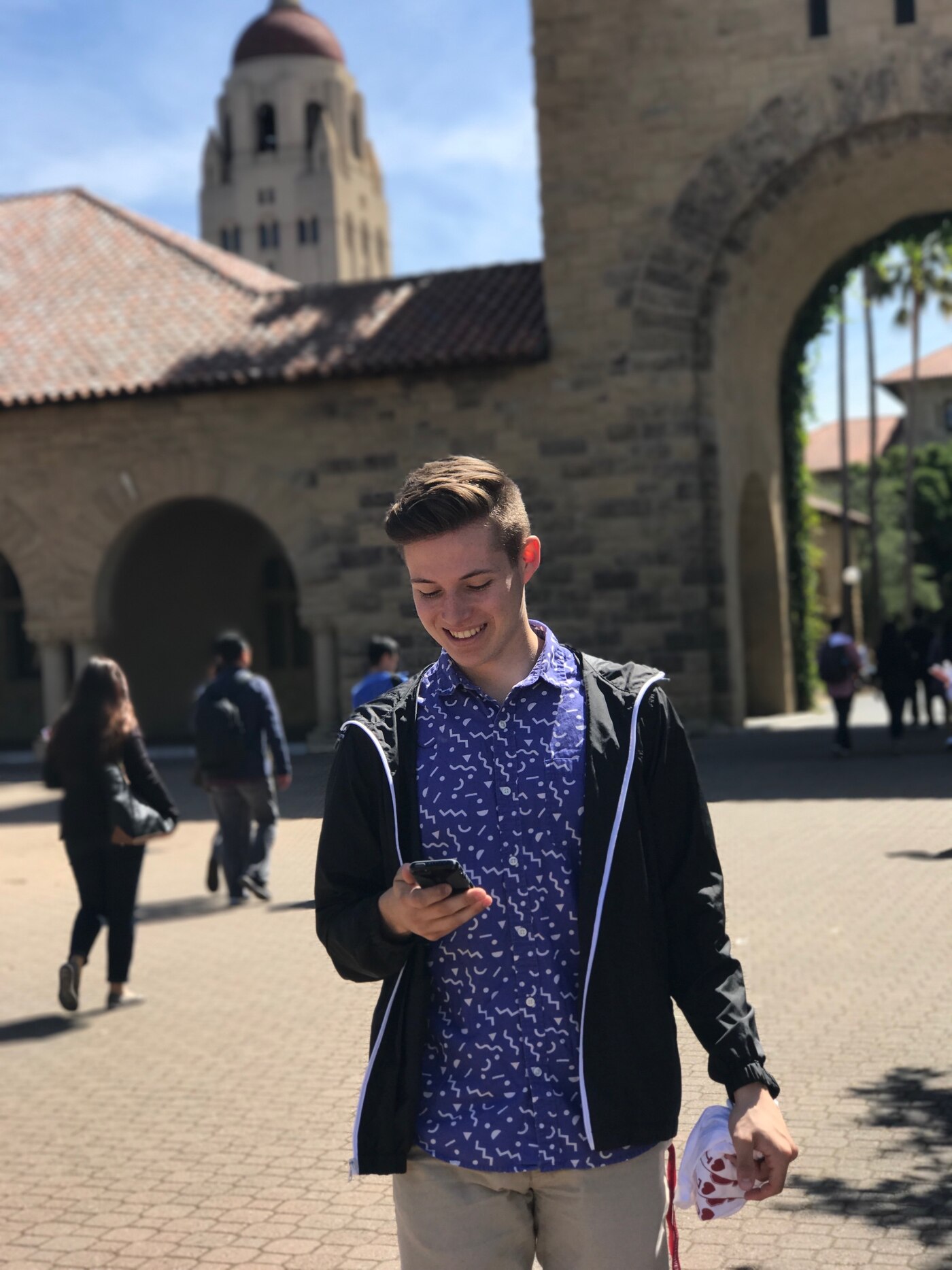 Admit Weekend at Stanford.
Footnotes
-
Full honesty: I also applied to Columbia, MIT, WPI, and four UCs. Everyone said yes except MIT. ↩
-
Okay, a mild flex. ↩
-
The ACT: I got a 35 in English, math, and science, a 34 in reading, and a 27 in writing. I thought the 27 was bad, but I guess it didn’t matter. ↩
-
My draft file has a few runners-up beneath this. Feynman’s “I could do that, but I won’t — which is just another way of saying that you can’t,” and Vonnegut’s “Science is magic that works.” I like the one from Breakfast of Champions, though, because it felt like the least on-the-nose, the most personal, and the most interesting. ↩
-
“The fox knows many things, but the hedgehog knows one big thing.” I built my essay on that dichotomy: “Although I approach many problems as a fox, I’m also part hedgehog.” So I was using two of those words to reintegrate with my essay. Honestly, I didn’t like trying to describe myself in words, and it felt like a landmine. I wanted to give as few opportunities to make a mistake as possible. ↩
-
The reason I added charismatic was because when I was applying to a Yale summer program a year before, I’d gotten waitlisted. To the dismay of the program director, I asked the admissions officer one night why she waitlisted me, and she said it was because she thought I came off as socially stunted in my essays. I used that feedback in my college essays to preemptively guard against that objection. In fact, I tried to make my entire college application a positive reading experience for the admissions officer, so that they would associate me with positive emotions. ↩
-
Something I was trying to keep in mind when writing the essays was that the admissions officers were looking for people who would fit into their campus. What does that mean? It means people who want to learn. A good application comes off as somebody who is eager to learn in college. ↩
-
After the AP exam, my physics teacher showed the class Euler’s method and mentioned fourth-order Runge-Kutta in passing. The next fall, when I asked him for a letter of recommendation, he sent me a self-assessment form. I put in: “You had mentioned the fourth order Runge-Kutta, so I decided to do a quick Google search. It seemed pretty manageable, and very interesting, so I gave it a try. I was shocked to see how slowly it accumulated error. And little did I know that this would actually be a major asset for my summer near-Earth asteroid research.” ↩