Brian Greene needed a website. I was 15.
My first company never had a name.
No LLC, no logo, no letterhead. It was a kid in San Diego building websites for money, and the kid could not drive himself to a client meeting. That was me, and for a few years, that was the business.
It started with a nonprofit
In high school I founded a little science nonprofit called ImpulScience. We put on science events for elementary school kids from border-affected schools, posing the demos as magic.1 At some point the nonprofit needed a website, and it never even occurred to me to hire someone. I was too excited to build the thing myself.
I am not reconstructing that from memory. I wrote it down at seventeen, on the little site I built to apply to college, in the present tense:
It all started because I was too obsessed with coding to ask a friend to make my nonprofit’s website. I’ve now been running a web development business for two years, building sites for companies and people like (renowned Columbia physicist) Brian Greene.
“Too obsessed with coding to ask a friend” is a better description of the founding than anything I could write now. And that parenthetical is a teenager who cannot quite believe his own client list either.
 The nonprofit’s logo, gears and all, from my camera roll. The website came with a subdomain I was extremely proud of: permission slips lived at permission.impulscience.org, because even the paperwork deserved good infrastructure.
That was the entire origin. I built one site because nobody else was going to, and then people started paying me to build theirs. One client turned into a referral turned into another referral, until ten companies and individuals had hired me — a photographer here, a small business there, each one arriving because the last one was happy.
I never named the company because naming it never came up. Nobody was hiring “an agency.” They were hiring the kid who could make the website. My college application eventually listed it as “Self-Employed Web Designer,” which is the closest thing to a name it ever had.2
At its peak, the company that didn’t exist had two employees. That is a strange sentence to write about a business with no name, but there it is: school on weekdays, client work whenever, and two other people helping me ship.
The paperwork survives, and it is exactly as professional as you’d hope:
INVOICE FOR SERVICES

Ben Clark
San Diego, CA
[email protected]

To: Chris Keeney
San Diego, California
Date: September 10, 2016

Date    Quantity    Description    Price
That’s a real invoice from the folder, sent to a real client — a San Diego photographer — typed into a Microsoft Word template whose original letterhead is still sitting two files away.2
Sending those was the hardest part of the job. Not the building. The asking. Read this one bottom to top:
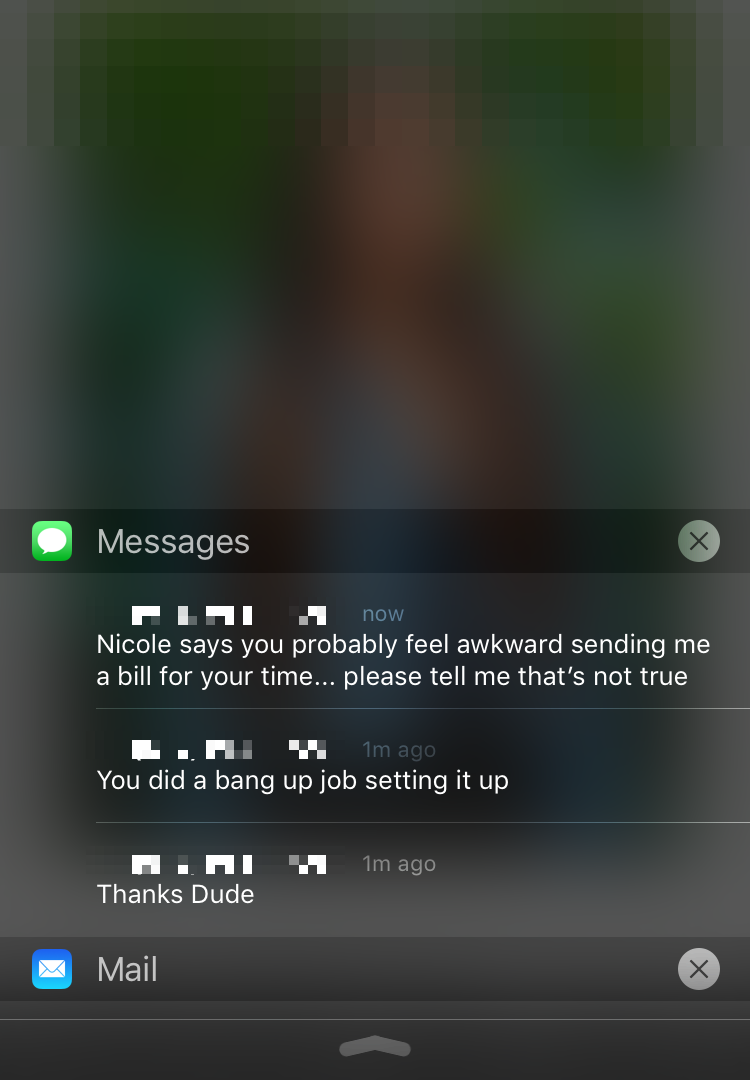 A client, unprompted, working up to it in three messages — and then his wife has to be the one to say it out loud. He was right. I did feel awkward sending him a bill, and he had to talk me into it, and that is the single most accurate portrait of what it is like to charge money for something at sixteen.
I sent the bills anyway, and here is why. The year the business got serious, my mom was diagnosed with MS. She was sick often, and sometimes she struggled to work. My earnings went to support her. My college application had a tiny box called “earnings purpose,” and that’s what I wrote in it. It is still the truest description of why a teenager who felt awkward about invoices kept filing them.
Then my hero became a client
At sixteen, I built Brian Greene’s website.
If you don’t know the name: Brian Greene is one of the most famous physicists alive. String theorist at Columbia. Wrote “The Elegant Universe.” The Washington Post called him “the single best explainer of abstruse concepts in the world today.”3
He was not an abstract famous person to me. When I described the client list in my college essays, I called him one of my heroes, and that was underselling it. I had a list of clients, and then suddenly the list included the guy whose books pulled me toward physics.
This is what he had before.
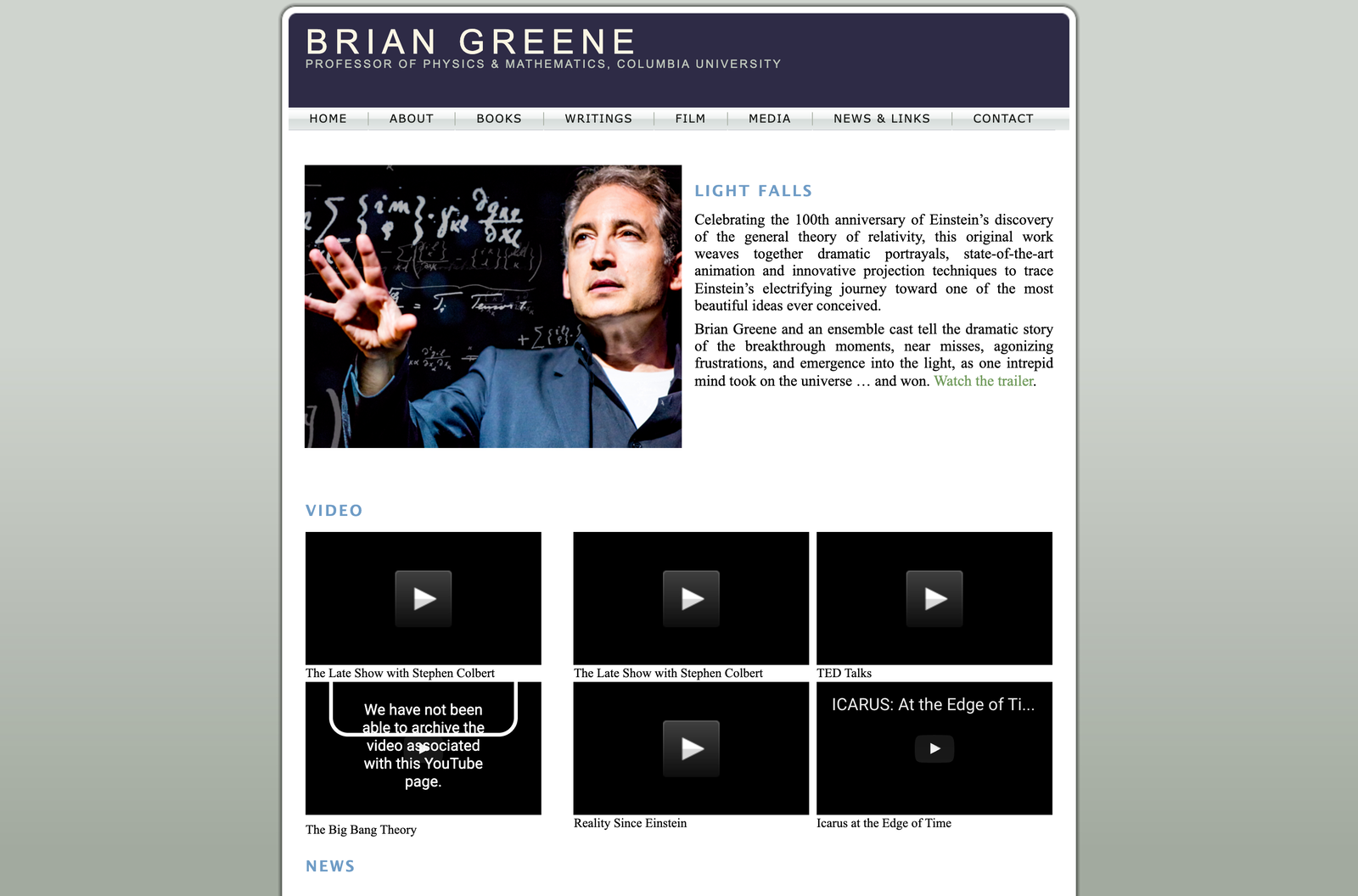 briangreene.org as the Internet Archive found it in 2016 — a boxed WordPress theme, justified serif body copy, a page that could have been any professor’s.
And this is what went live.
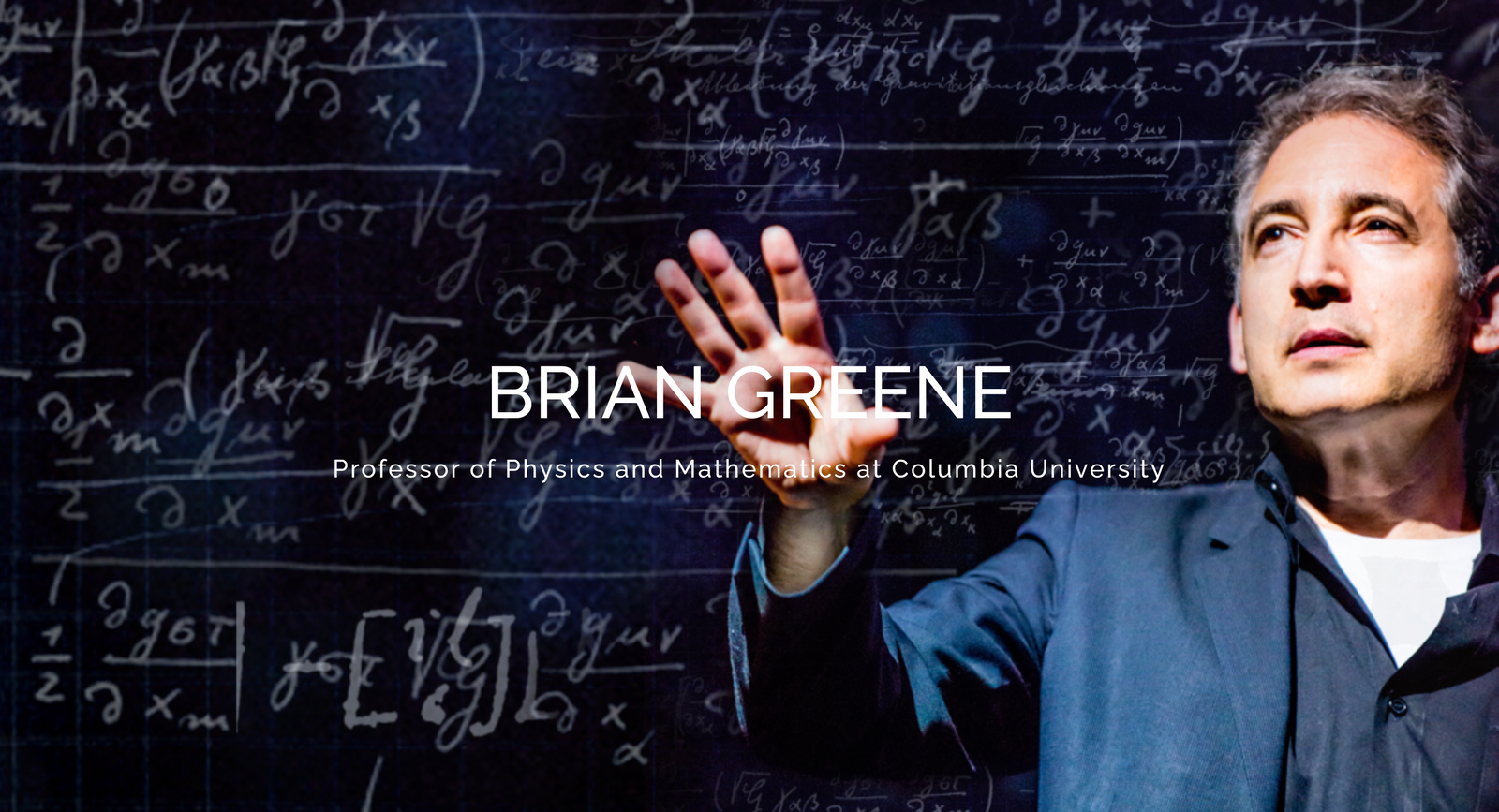 The homepage that replaced it, still the homepage today. Same man, same blackboard photograph he already owned. Mostly I stopped putting a box around him.
And the work wasn’t dropping a bio into a template. I went through his page copy like any other client’s, condensing the long academic bio into a short one a visitor would actually read.4 Then the fun part: I wrote a physics simulation for the site that animates Greene’s childhood story. A teenager’s code, running a little piece of physics, on the website of the man who does physics on television.
The story is the one Greene tells about the moment mathematics turned real for him. He was in AP Physics. The problem was a baseball stuck to the ceiling by a piece of chewing gum, swinging while the gum stretched, and the question was the trajectory. He worked it out at his desk and then — his words — ran down the hallway to his dad to show him the formula that would tell you what the baseball would do.
I was also in AP Physics. My teacher had just handed us a Lagrangian: a pendulum hanging off a spinning wheel, which is the same species of problem, a swinging mass with a moving anchor. So I solved that one numerically, hung a baseball on the end of it, and matched it to his audio.
 The class in question. Greene had his baseball-and-chewing-gum problem in AP Physics and ran down a hallway about it; I had mine and put it on his website. Same course, sixty years apart.
MATHEMATICS & REALITY
Professor Greene has long been fascinated with the power of mathematics in describing our world. Hear him describe a childhood experience that fostered this appreciation.
The parameters are randomized on every page load — the wheel gets between three and ten spokes, a new radius, a new rope length, a new spin — so nobody has ever seen quite the same swing twice.5 Nine years later, all of that still runs, and it still calls its assets off the dev subdomain I was testing on.
The working files survive too. There’s a document in the Greene folder with two sections, “Old text” and “Short version” — his full academic biography, and my teenage condensation of it. Somewhere in that folder, sixteen-year-old me is deciding which of the Pulitzer finalist’s accomplishments make the cut.
What I remember most is the feeling of the gap. On one side of the screen, a man who thinks about extra dimensions of spacetime for a living. On the other, a teenager adjusting margins in a bedroom in San Diego.
Every good thing that happened to me as a teenager traces back to this one fact. The person on the other end of an email has no idea how old you are.
And then he did the thing that still slightly stuns me: he wrote one of my letters of recommendation for college.
Think about the sequence. A teenager cold-emails his way into a job, does the job, and the client — a Columbia physicist, a Pulitzer finalist, a man who has been on television explaining spacetime — turns around and vouches for him to admissions committees. I have no idea what it said. You never do. But somewhere in a file at a university I ended up attending, there was a page about me signed by the guy whose books got me into physics in the first place.
At the time, Brian Greene was just my most famous client. We ended up actually talking, later on, about science popularization and the online school he was building for people who never stopped asking questions.6 The physics thread that started with his books kept going.
But back then he was simply the biggest thing ever shipped by a company with no name, run by a kid who had to get dropped off.
The company still has no name. The site still has my name on it.
 The bottom of briangreene.org, today.
And that one line turns out to be a strange little record of my life, because I have quietly maintained it. Here is every version the Internet Archive and the live page can account for:
- 2017 — “Designed by Ben Clark,” linking to
[email protected]. My high school email address, on the site of a Columbia physicist. - Later — same name, linking to
[email protected]. - Today — “Designed by Ben Sage,” linking to
[email protected].
Same eleven-word line, three identities. It tracks the name I go by before and after I changed it, and it tracks where I could be reached at seventeen, at nineteen, and now — school, university, my own company. Nobody has ever asked me to update it. I just do, every few years, the way you'd repaint a fence you no longer own.
Footnotes
-
The trick at the end of every ImpulScience event was revealing that none of it was magic. The paperclip floats because electrons line up. Kids handle that reveal better than adults do. ↩
-
For a while my invoice template was Microsoft Word’s lawn-care invoice with my name swapped in at the top. A draft still sitting in my files claims I spent January mowing lawns in Yardville, New Mexico. I have never mowed a lawn in Yardville, New Mexico. ↩ ↩2
-
I know this quote because I typed it. When you’re condensing your client’s bio, you end up reading a lot of sentences like that about the person reviewing your work. ↩
-
The Columbia essay in my application archive describes the result in the present tense: “My own physics simulation now animates Columbia physicist Brian Greene’s childhood story on his website.” It still does. ↩
-
The stray
<title>tag I left inside the page says “Runge-Kutta Physics,” which is what I thought I was writing. It is a fourth-order Runge-Kutta integrator in shape — four stages, the sixth-weights, all of it — but the acceleration function it calls ignores the intermediate angle it gets handed and reads the global one instead, so all four stages evaluate the same number and it quietly collapses to something much dumber. Nobody has ever noticed, because a swinging baseball looks like a swinging baseball. I have left it exactly as it is. ↩ -
World Science U, his site for learning physics from the people who discovered it. He described it as being for all those kids who never grew up. I think about that phrase a lot. ↩