I rented out parked cars to Uber drivers
Let me be precise about the claim in the title, because precision is the whole point of this blog. At Stanford, I worked at a very small startup called OXO that rented out parked cars to Uber drivers. I was not the founder. I was not employee number two. I was the intern.
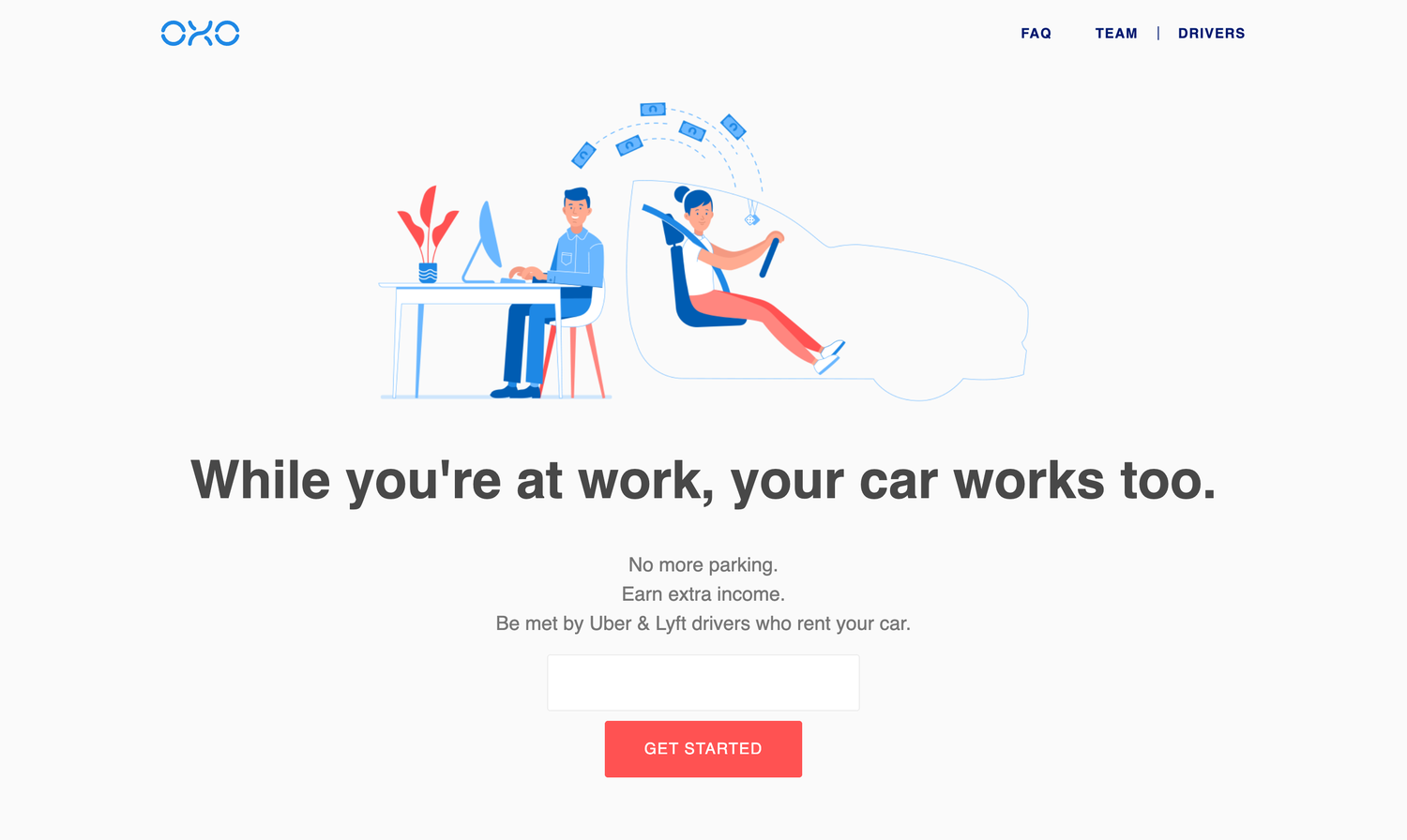 The whole company in one sentence, from the first version of the site the Internet Archive ever caught: “While you’re at work, your car works too.” Underneath, three lines — no more parking, earn extra income, be met by Uber & Lyft drivers who rent your car. The illustration is doing something clever: the money flows from the driver’s seat back to the desk.
But I did personally find customers, and I personally facilitated rentals: real cars, real owners, real drivers, with me in the middle making it happen. So the title is true, it just comes with an org chart. OXO was other people’s company — legally Oscar Technologies, Inc., incorporated in California in July 2017, run out of Palo Alto and then a unit on Howard Street — a handful of Stanford people, and roughly ten people ever touched the code.1
It was also better funded and better decorated than the word “intern” makes it sound. The seed round was three million dollars, led by Founders Fund.2 One of the two people I sat next to made the Forbes 30 Under 30 list for it. The intern seat is still the best seat for this story, though, because the interesting thing about OXO was never me. It was the model.
The most underused asset in America
Here is the observation the whole company sat on. A car is the second most expensive thing most people ever buy, and it spends roughly 95 percent of its life parked.3 Not driving. Parked. You pay it off monthly, you insure it monthly, it loses value monthly, and for about 23 hours a day it does absolutely nothing but occupy a rectangle of asphalt.
Now look at the other side of the street. Uber had turned driving into an open job: anyone could earn money tonight, if they had a qualifying car. And a surprising number of would-be drivers didn’t. Their car was too old, or the wrong type, or they simply didn’t own one. The job existed, the workers existed, and the tool sat idle in a parking lot two blocks away, owned by someone who was at a desk until six.
OXO’s move was to connect those two facts. Your parked car becomes a driver’s workday. The driver gets a car without buying one. You get a check for the hours your car would have spent depreciating in silence. OXO takes a cut for making the match. Arbitrage on idle steel.
The company took the two-sided part literally: it shipped as two separate apps, one for owners and one for drivers, each with its own backend.4 And the repos are honest about what a marketplace actually is once you strip the romance away. There’s an authentication flow. There’s a background check integration for the drivers. There’s a Stripe pipeline for moving the money. And there’s the matchmaking logic, a helper file literally named generateMatches.js. That’s the whole company, mechanically: identity, trust, payment, match. Everything else was people.
What the intern actually did
At a startup that small, “intern” is a payroll category, not a job description. The job description is: whatever the company needs that day, which is mostly finding people.
So I found people. I found car owners and talked them through the idea of a stranger driving their car for money. I found drivers who wanted seats. And when the two sides matched, I facilitated the rental itself: the introductions, the walkthrough, the handoff.
The paper trail from that job is still on the public internet, and it starts with my own face on the company website.
 joinoxo.com/team/ben-clark, as the Internet Archive caught it in August 2019. Every intern got a page and a one-liner. Mine committed, in writing, on my employer’s domain, to being a person who is “(sometimes) curling.” The parenthetical is the only honest part.
There is also a Medium post titled “OXO Driver Guide”, from August 2019, and the byline is Ben Clark, because the intern also wrote the manual. My favorite line in it is the profile-photo instruction — “take a selfie, it’s the first thing your car owner will see” — and the price, stated once, plainly: fifty dollars a day.
The founder, a Stanford GSB grad named James Pelly, took the company on after my era. OXO landed a page at Stanford’s TomKat Center with a climate pitch attached — successful pilots “could result in 3,900 fewer cars on the road in the Bay Area” — and the marketing kept getting better at compressing the idea. The mission page settled on: it’s like Airbnb and Tesla had a lovechild. The Twitter bio was three words: “Emulating autonomous vehicles.” Which, if you think about it for a second, is exactly what the company was. If a car could drive itself to a job while you worked, you would not need OXO. OXO was a person doing the self-driving part.
My favorite artifact is the FAQ, because it is where the marketing stops and the operations start. The cars were for professional use only, and here is how that rule was written: “No trips to the supermarket, circus, IKEA or the beach.” Somebody had to have been asked about the circus.
Eventually they let me into the codebase too. My entire committed contribution to the driver backend is two commits, and both of them are about moving money through Stripe.5 The intern got the payments plumbing, which in hindsight is either enormous trust or an excellent prank.
Renting someone a car is easy. Convincing someone to hand their own car to a stranger is the actual product.
What I remember most is which side was hard. Drivers were easy: the pitch is “here is a way to make money,” which sells itself. Owners were the boss fight. The pitch there is “let a stranger use the second most expensive thing you own, for hours, out of your sight.” Every objection is reasonable. What if they crash it? What if it comes back smelling like a night shift? You are not selling a rental; you are selling the answers to those questions. That’s why the trust machinery, the background checks and the payment rails, wasn’t back-office plumbing. It was the product. The economics were never the objection. Trust was always the objection.
That asymmetry has a name in marketplace land: the risk-bearing side is the constraint. At nineteen-ish I just knew it as “owners take ten times longer to close.” In class, supply and demand are curves. At OXO, supply was a specific guy with a specific Camry and a specific fear about his upholstery, and the market cleared because somebody did the unscalable work of making both humans comfortable. Usually in person. Usually twice.
What happened to OXO
My repos go quiet in August 2019, but the company ran for years after that, and its ending is legible if you go looking. I went looking.
The rideshare blogs reviewed it like the real business it had become, and the review is rough. The writer rented a 2011 Hyundai Sonata for a day, found the car “disappointingly grubby” and the fuel gauge wrong, was told by OXO that the car was a hybrid, ran the VIN himself, established that it was not, and was refused reimbursement. His verdict: he would try any option before using OXO again. Reading that as the guy who used to hand those keys over in person is its own small education. The unscalable work I was doing was the product, and it is exactly the part that does not survive scale.
By then the pitch had drifted too. The 2021 site is no longer about parking at all — it is a gig-work platform offering “jobs in rideshare, delivery, childcare and logistics,” and offering to supply you a smartphone and help you open a bank account. That is a company looking for a different problem to solve.
Then it just stops. The last app update is April 2021. The team page disappears from the navigation. The site freezes and sits there for four years, unchanged except for a copyright line that keeps auto-incrementing itself — 2022, 2023, 2024, 2025 — a dead page politely updating its own tombstone. The San Francisco business registration closes on the last day of 2023. Both apps get delisted. Today the domain still resolves and returns a 403.
And the idea itself was right, or at least early. Renting cars to gig drivers became a real category: whole companies were later built on exactly this wedge, and the rideshare platforms themselves eventually got into rental partnerships. Being correct, as I’ve learned repeatedly since, is a necessary and wildly insufficient condition.
That’s the real reason I still think about OXO. I’ve since run my own company, but this was the first time I watched a business get willed into existence up close: not announced, not launched, but assembled one persuaded stranger at a time. I was the intern. The intern does the assembling.
There was no shutdown post, no acquisition, no obituary. For a company that raised three million dollars from Founders Fund and put a founder on the Forbes 30 Under 30 list, the total independent press coverage is one skeptical rental review. That is the part I did not expect to find, and the part I keep thinking about: you can do everything visibly right and still leave almost no trace.
Footnotes
-
The git history is, overwhelmingly, a guy named Tevon. Every startup this size has a Tevon. If yours doesn’t, you’re the Tevon. Tevon Strand-Brown is the one who made the Forbes list, went on to found a database company and then to Palantir, and who — in a nice bit of symmetry with this blog — describes OXO on his own site in exactly seven words: “Carsharing for Uber/Lyft drivers.” ↩
-
Peter Thiel’s firm, per Tevon’s Forbes profile; the startup databases instead credit Craft Ventures, who ran an OXO page on their portfolio job board. My read is that Founders Fund led and Craft came along, but I’m hedging because the public record disagrees with itself. ↩
-
This stat gets cited everywhere transportation people gather, and once you hear it you can’t unsee a parking lot. It’s not a lot of cars; it’s a lot of idle capital. ↩
-
I still have all of it on disk: driver-frontend, driver-backend, owner-frontend, owner-backend, plus the landing pages. The database migrations start in August 2018. Reading your old startup’s migrations is the closest engineering gets to flipping through a scrapbook. ↩
-
The commits are authored by “Ben Clark.” That’s me. Another story. ↩